

The best techno production tools are not necessarily the most expensive plugins, the newest synthesizers or the largest software bundles.
A strong techno production setup is usually built around a focused selection of tools that help you control rhythm, synthesis, distortion, dynamics, space and arrangement. The real advantage comes from understanding what each tool contributes to the track rather than collecting hundreds of plugins that rarely become part of your workflow.
Whether you produce raw, hypnotic, tribal, groove-oriented or harder techno, these are the core tools and techniques worth prioritizing.
1. A DAW You Know Extremely Well
Your digital audio workstation is the center of the entire production process.
Ableton Live, FL Studio, Logic Pro, Bitwig and other modern DAWs are all capable of professional techno production. What matters most is how quickly you can translate an idea into sound.
For techno production, your DAW should let you move efficiently between:
- Drum programming
- Audio editing
- MIDI sequencing
- Automation
- Resampling
- Effects processing
- Arrangement
- Mixing
Speed matters because techno often develops through experimentation. A percussion loop may become a bass texture. A synth may be recorded, distorted and transformed into something completely different.
The fewer technical obstacles between your original idea and the finished track, the better.
2. Sampling and Drum Programming
Percussion remains one of the foundations of techno.
A flexible sampler gives you a fast way to load, layer, tune, sequence and manipulate:
- Kick drums
- Claps and snares
- Hi-hats and rides
- Toms
- Metallic percussion
- Found sounds
- Noise
- Loops
Sampling can be more valuable than constantly adding new synthesizers. Simple source sounds can become highly distinctive through pitching, filtering, envelopes, saturation and resampling.
This is especially useful in raw and hypnotic techno, where a few carefully processed sounds can define the entire character of a track.
3. Saturation and Distortion
Distortion is not only useful for aggressive techno.
Used carefully, saturation can introduce:
- Harmonic content
- Density
- Perceived loudness
- Texture
- Movement
- Character
A clean kick can become more physical. A percussion loop can become rougher and more present. A sterile synthesizer can gain instability and personality.
The important distinction is between adding useful character and simply destroying the signal.
Good distortion should reinforce the groove rather than remove clarity from it.
4. EQ and Frequency Control
Equalization remains one of the most important tools in any techno production setup.
Dense electronic music often contains several elements competing for similar frequency ranges. EQ helps create separation between:
- Kick and bass
- Percussion
- Synthesizers
- Effects
- Vocals
- Atmospheres
The goal is not to aggressively EQ every channel.
Listen for unnecessary energy and frequency collisions. Sometimes removing a small amount of information creates more impact than adding another layer.
5. Compression and Dynamics
Compression can control peaks, increase consistency and change the physical behavior of a sound.
In techno production it can be particularly useful for:
- Drum buses
- Percussion groups
- Bass
- Parallel processing
- Sidechain relationships
- Aggressive sound design
However, compression should not automatically be placed on every channel. Many electronic sounds are already highly controlled.
Use dynamics processing when it solves a specific problem or creates a deliberate effect.
6. Filters and Automation
Filters are fundamental to techno because they create movement without requiring completely new musical elements.
A filter can transform one repetitive loop over several minutes through subtle automation.
Useful automation targets include:
- Cutoff frequency
- Resonance
- Drive
- Envelope amount
- Effect sends
This becomes particularly powerful in hypnotic techno, where gradual changes can produce more tension than dramatic arrangement shifts.
7. Delay and Reverb
Space is part of the composition.
Reverb creates depth. Delay creates repetition and movement.
Together they can transform relatively simple sounds into complete environments.
They are especially useful for:
- Percussion tails
- Dub-style echoes
- Metallic environments
- Transition effects
- Synth movement
- Background textures
The challenge is preserving clarity. Too much reverb can remove impact from drums and blur an otherwise powerful mix.
8. Modulation Tools
Movement is essential when working with repetitive structures.
LFOs, envelopes, random modulation and automation allow small parameters to evolve continuously without requiring new notes or additional tracks.
Useful modulation targets include:
- Filter cutoff
- Resonance
- Pitch
- Delay feedback
- Reverb sends
- Distortion amount
- Sample position
- Stereo width
- Decay
This is one of the keys to making repetition feel hypnotic instead of static.
9. Spectrum and Metering Tools
You should primarily mix with your ears, but visual analysis can reveal problems that may be difficult to identify on one monitoring system.
Useful metering tools include:
- Spectrum analyzers
- Peak meters
- LUFS meters
- Stereo correlation meters
These can help reveal excessive low-frequency information, resonances or stereo problems.
Use meters to confirm what you hear rather than replacing critical listening.
10. Resampling: One of the Most Powerful Techno Tools
Resampling is less a plugin and more a production technique.
It is also one of the most powerful tools available to techno producers.
The process is simple:
- Create a sound.
- Process it.
- Record it.
- Manipulate the recording.
- Process it again.
A synthesizer can eventually become percussion. A drum can become atmosphere. A vocal can become an abstract rhythmic texture.
This iterative process is responsible for much of the character associated with raw and experimental electronic music.
Do You Need Expensive Plugins to Produce Techno?
No.
Modern DAWs already include extremely capable EQs, compressors, saturators, delays, reverbs, filters, samplers and synthesizers.
Third-party plugins can improve workflow or provide a particular sound, but they cannot replace an understanding of production fundamentals.
A producer who understands ten tools deeply will often work more efficiently than somebody constantly moving between hundreds of plugins.
Hardware vs Software for Techno Production
Hardware can provide immediacy and physical interaction. Software provides flexibility, precision and recall.
Neither approach is automatically superior.
Hardware can be useful for:
- Hands-on sequencing
- Live improvisation
- Analog sound generation
- Immediate parameter control
- Creating productive limitations
Software can be useful for:
- Precise editing
- Fast arrangement
- Total recall
- Complex automation
- Large-scale processing
- Resampling
Many producers combine both approaches. The best setup is ultimately the one that allows you to finish music consistently.
Reference Tracks Are Production Tools Too
One of the most overlooked production tools is a strong reference library.
Reference tracks can help you evaluate:
- Low-end balance
- Kick weight
- Percussion density
- Arrangement
- Stereo width
- Frequency balance
- Energy progression
The purpose is not to copy another producer.
A reference provides context and helps answer practical questions: Is the kick too loud? Is the track too dense? Does the arrangement lose energy? Is there enough space around the percussion?
A Relevant T.A.M Reference: Tools
For producers and DJs exploring the T.A.M catalog, Tools by T.A.M is a relevant musical reference alongside the production concepts discussed in this guide.
Tools is a Bandcamp album, not a plugin bundle or production software package.
According to the available historical Bandcamp data, the release recorded 44 purchases, approximately USD 562 in historical net revenue and around USD 12.77 in net revenue per unit.
Those figures do not predict future performance, but they show meaningful historical buyer activity within the available catalog data.
T.A.M — Tools
Explore the full album and use it as another reference point for T.A.M’s approach to techno.
What Techno Production Tools Should a Beginner Use First?
Before purchasing large plugin collections, prioritize the essentials.
A practical starting setup is:
- One DAW
- One reliable sampler
- One versatile synthesizer
- EQ
- Saturation or distortion
- Compression
- Reverb
- Delay
- Metering
- Reliable monitoring or headphones
Many of these tools may already be included with your DAW.
Learn them first. Expand only when you can clearly explain what your current setup cannot do.
Best Tools for Hypnotic Techno
For hypnotic techno, modulation and gradual movement become particularly important.
Prioritize:
- Filters
- LFOs
- Delay
- Reverb
- Resampling
- Percussion processing
- Automation
You may only have a few musical elements running at once, so small changes become much more noticeable.
Best Tools for Raw and Hard Techno
For harder and rawer productions, sound-shaping tools often become more important.
Useful categories include:
- Saturation
- Distortion
- Clipping
- Drum processing
- Resampling
- Compression
- EQ
- Transient control
The objective should still be controlled aggression. More distortion does not automatically create more impact.
Plugins vs Samples: Which Should You Buy First?
That depends on your main limitation.
If your sound palette feels weak, better samples may help. If you already have good source material but struggle to shape it effectively, learning processing tools may provide more value.
Before purchasing either, ask one question:
What specific production problem am I trying to solve?
That question can save producers a significant amount of money.
Frequently Asked Questions
What are the most important tools for techno production?
A reliable DAW, sampler, synthesizer, EQ, saturation, compression, delay, reverb, modulation and metering tools provide a strong foundation for most techno production workflows.
Can you produce professional techno with stock plugins?
Yes. Modern DAWs contain powerful stock instruments and effects. Third-party plugins can improve workflow or offer specific sounds, but they are not required to make strong techno productions.
What production tools are most useful for hypnotic techno?
Filters, modulation, delay, reverb, automation and resampling are especially useful because hypnotic techno often depends on subtle evolution within repetitive structures.
What is the best techno production tool for beginners?
The best starting point is the DAW you already use. Learn its sampler, EQ, compressor, saturation, reverb, delay and automation tools before investing heavily in additional software.
The Best Techno Production Tool Is a Focused Workflow
It is easy to believe that another plugin will unlock better music.
Sometimes a new tool helps. More often, progress comes from better sound selection, listening, arrangement, deliberate processing and finishing more tracks.
A simple setup that you understand completely can be extraordinarily powerful.
The tools matter. Knowing why and when to use them matters more.
Final Recommendation
The best techno production tools are those that help you move quickly from an idea to a finished track while maintaining control over rhythm, texture, dynamics and space.
Start with a DAW you understand, strong sampling tools, EQ, saturation, dynamics, filters, reverb, delay, modulation, metering and good reference music.
Then expand your setup according to actual production needs rather than collecting software for its own sake.
For another musical reference within the T.A.M catalog, explore Tools by T.A.M, one of the stronger historically performing products in the available Bandcamp data.
Explore T.A.M — Tools
Listen to the complete album on Bandcamp and support the artist directly.
 Playlist Extractor: Copy Rekordbox Playlists from Your USB
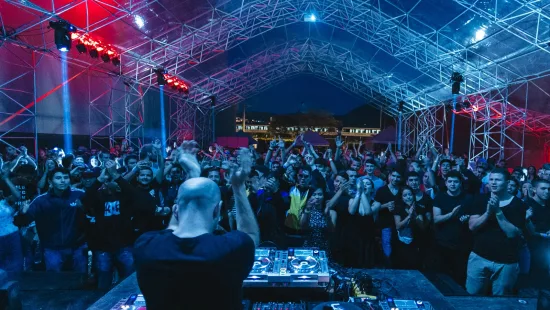 From Techno to Recovery: The First Month of Support for Colombia
 Hardgroove vs Hard Techno: Why Swing, Funk and Percussion Are Winning in 2026
 Hypnotic Techno: How Repetition, Space and Subtle Motion Build the Groove
 Tribal Techno: How Percussion, Groove and Polyrhythm Shape the Sound
 Top 10 Essential VSTs for Producing Techno